



Let’s face it, when it comes to snowmaking, Mother Nature has grown increasingly unreliable. But skiing in New Hampshire remains essential to our nature and economy and the ski industry relies more and more on snowmaking to keep skiers returning to the slopes. Enter New Hampshire Electric Cooperative.
The Co-op partners with a number of ski areas to help them achieve their efficiency goals – reduce the amount of electricity needed to produce the powder and create a better product – and keep the economic engine that is New Hampshire’s ski industry humming. Here’s a look at two Co-op commercial members – Cranmore Mountain Resort and Waterville Valley Resort – which have helped shape the nature of what it means to ski New Hampshire.
Cranmore Mountain Resort
They like to refer to natural snow as frosting on the cake. But what bakes the cake and allows ski areas to operate and give today’s skiers a better experience that meets their demands is man-made snow that provides thicker, fluffier, silkier slopes. Thanks to cutting edge high efficiency snow guns, New England’s decades-long reputation of “ski the ice coast” has been melting away.
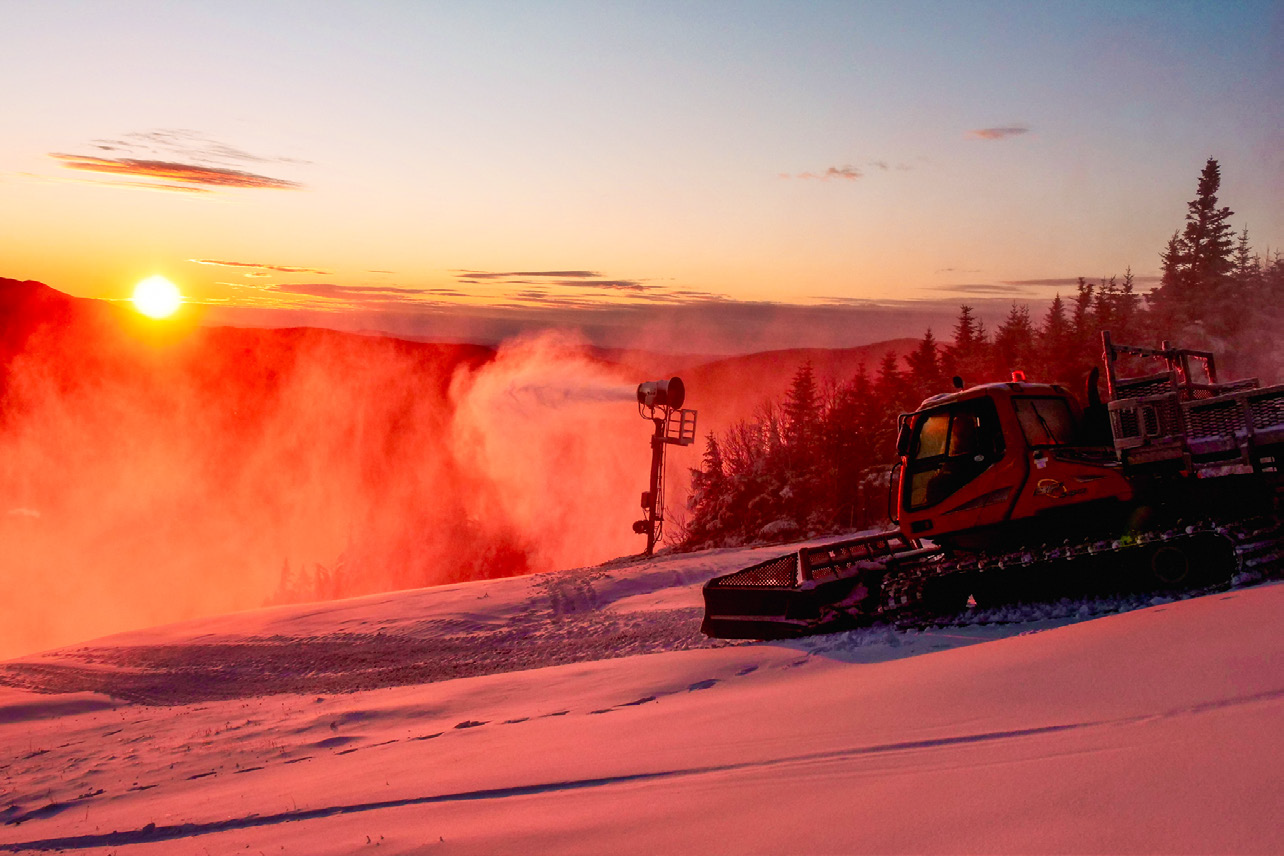
So while the elements can be unreliable with offerings of rain or natural snow, snow guns are not. Take temps in the low 20s to high teens and low humidity, mix in water and air with some pressure and voila: Less energy powers more snow made in less time, allowing trails to keep opening as the season unfolds.
“We rely on a snowmaking plan and it’s a big part of our operation so we can stay in business,” said Ben Wilcox, President and General Manager of Cranmore, noting that the season mainly begins at Christmas and kicks into high gear around the Martin Luther King Day weekend and beyond.
“The Co-op has supported and encouraged us to continue to use energy efficient equipment. It uses less energy and is less taxing on the power system. It’s a win-win saving on electricity and making more snow faster,” Wilcox said, noting that in his time at Cranmore since 2004, the Co-op consistently has helped them with rebates on the equipment, as well as loans through the Smart Start program. Smart Start enables businesses to borrow from the Co-op to buy energy efficient equipment in years when their funds don’t permit expansion.
About 30 years ago, a lot of smaller ski areas closed because they could not sustain the cost of relying on natural snow. “That would not be a good strategy today,” said Wilcox.
Though rudimentary versions of snow guns came on the scene in the 1950s, it was not until about the 1970s when really aggressive snowmaking plans became critical to run a ski area, he said. Some 20 years ago, higher energy efficient snow guns started to blanket the market. The engineers and companies developing them have continued bettering the technology, requiring less air with many of today’s guns, producing snow quantities in greater multiples in less time and doing it much more quietly. Today, Cranmore is replacing energy efficiency guns from the early 2000s, Wilcox said.
“The Co-op has been a great partner of ours. They’ve helped us keep in business and thrive,” he said. “They’re always a phone call away if we need anything.”

Waterville Valley Resort
Tim Smith, President and General Manager of Waterville Valley Resort, says that these days the typical winter sees natural snow followed by warmer temps that melt it. This is not good for customer demand.
“The big thing now is that our customer demand is so high for snow quality to be much deeper and thicker than it ever was before,” Smith said. “We have a much better quality of product because of the new efficiencies we now have with our snowmaking systems. We’re able to produce the quality of snow that our customers desire.”
Over the years, Smith said, the Co-op has become very knowledgeable in the efficiencies of the technology.
“It’s been a really critical partnership in helping us move forward. Without the Co-op we would have been moving at a snail’s pace,” Smith said. “We’ve been able to expedite and move all of our infrastructure into this century much quicker.” He describes the snowmaking process poetically, a young man’s game. “It’s like working on the dark side of the moon up here in the middle of the night with a miner’s light on you.” The best times for snowmaking are the calm nights in shining moonlight.
“You don’t even have to use your headlamp because the moon is so bright. You just get these beautiful plumes of snow. It’s magical. It’s absolutely magical,” he said.
Smith estimates that Waterville Valley has replaced about 80-85 percent of their older snow guns with high efficiency models. Each year, they continue to take on a certain number of projects to decrease the low pressure areas on their mountain and increase the number of high efficiency guns, which need high pressure but deliver a product more like natural snow. “Think of it as putting a thumb over the end of a garden hose – water spews out. But if you put a finger over it, it sprays like a mist. That’s what we are looking for,” he said.
Smith said they did a study to see how they could reduce their electricity usage and carbon imprint. The number one thing was to reduce the amount of electricity they used.
“We’ve drastically reduced how much electricity we use for producing snow and at the same time, increased the amount of snow we can make,” he said. Last year, when Waterville thought they might have to pass on a snowmaking project, the Co-op approached them about the Smart Start program.
“That project alone saved us a significant amount of kWh (kilowatts per hour) and it pays for itself over the life of the loan. As we pay that down, we can roll that forward and continue to modernize our system and basically have it pay for itself,” Smith said.
Seasonal Jobs
Ski area visitors were estimated to have spent approximately $384.2 million in the 2017/2018 season at and away from ski areas within New Hampshire for tickets/admissions, lodging, restaurant meals, groceries, transportation and others, according to the Economic Contribution of the Ski Industry in New Hampshire, a report prepared for Ski New Hampshire, published in 2019, the last year for which study figures are available. As a result of this spending, it is estimated that almost 6,000 jobs were created in the 2017/18 season – the fifth largest industry in the state’s northern and western seven counties.
Each ski season, both Cranmore and Waterville Valley each create jobs for more than 500 people, many of them part-time. In turn, given the growth in ski area visitors, other businesses such as hotels, restaurants and other retail operations also employed more people.