





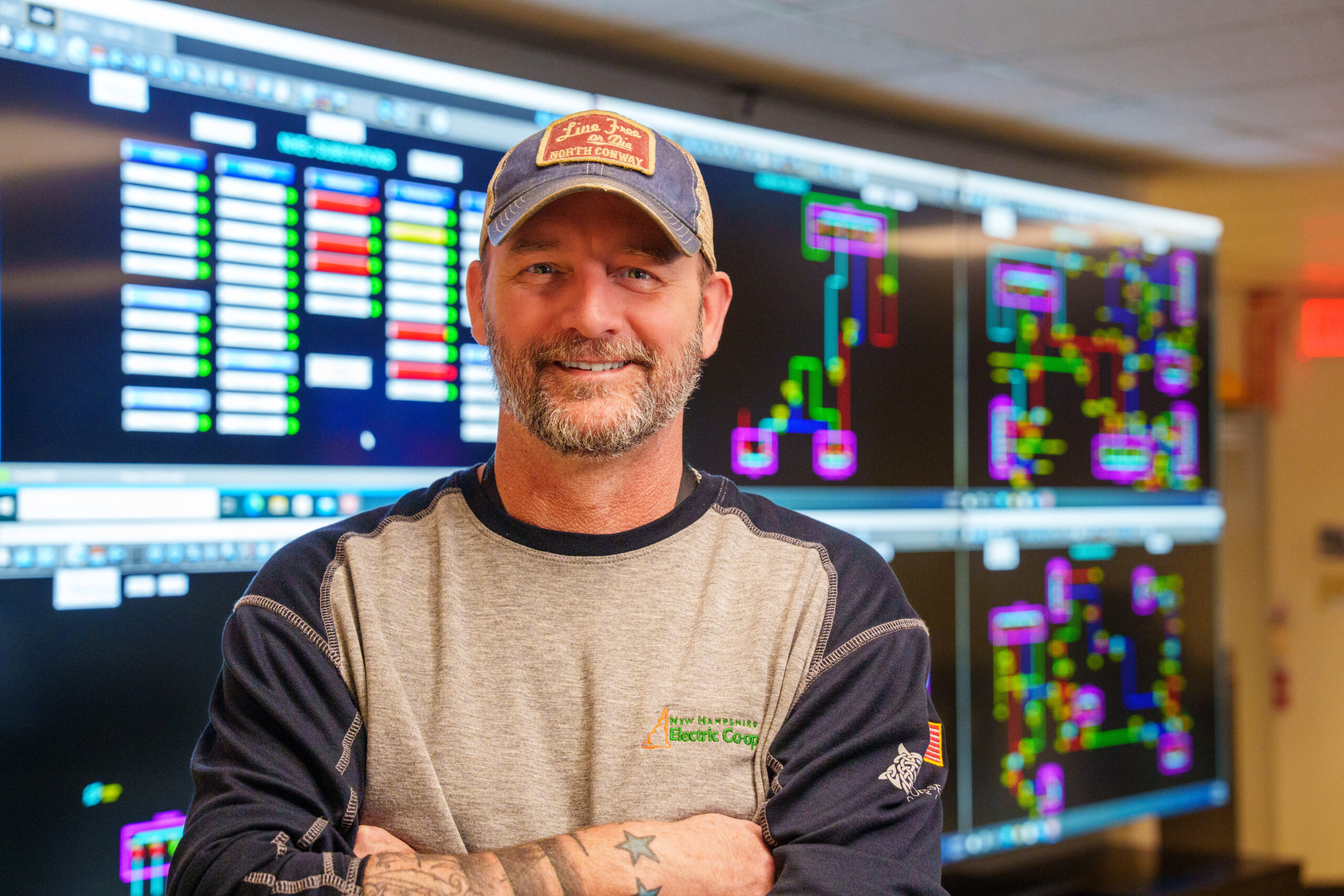
Our Co-op Control Center could easily be called the ‘Nerve Center.’ Whether we have calm, blue sky days or are in the midst of a raging winter storm, the Control Center has eyes on our entire electric system. They sidestep problems to keep the power on and lead the way to restore power when it’s lost. Twenty-four hours a day. Seven days a week.
To better understand what happens in the process of providing reliable service to our members, we sat down recently for a Q&A with Systems Operations Supervisor Tommy Komola. Tommy started out on the line, cross training in both overhead and underground lines, and worked as a lineworker in Massachusetts for about 13 years. He went on to hold supervisory positions for another 13 years before joining the Co-op as an Operator just over three years ago. Today, Tommy oversees a staff of six Operators and a Lead Operator. Whether it’s monitoring outages from our SCADA devices, incoming calls, weather-related issues or maintenance, Tommy’s office is the hub and he keeps an eye on all of it to make sure that everything is running smoothly.
Q: When a widespread storm hits, what happens in the Control Center?
TK: The Control Center is definitely the heartbeat through everything, but on a widespread outage, everything comes through here. Everyone out in the field – from the Operation Supervisors, working foremen, birddogs and all the lineworkers – are very good about understanding how busy it gets in the Control Center. We have nine districts and they’re all trying to call in at the same time. The best we can do when we are doing a multitude of things is hit the button and say, “Stand by.” As soon as we say that the folks in the field know that they’ve been heard and that they are not in an area with no sound or cell service. They know we are in the middle of something and we have to get that information into the system right away. It gets very demanding in here during a major storm, but the Operators are well-trained to handle these situations. We work with municipal responders from police, fire and towns all day long from all over the state. They call into a municipal line that we have and that is constantly ringing with all the emergencies.
Q: What’s staffing like?
TK: We are a 24/7, 365 day operation. On a blue sky day we have two Operators on with a Lead Coordinator, four days a week. At night, it’s generally always one person. During storm, I’ll staff three operators during the day and two at night, due to the volume, municipal calls and activity.
Q: Why does my neighbor across the street have power and I don’t?
TK: It’s very situational. It could be that both houses are on a three phase circuit and two phases are still energized while one is not. The house on this side of the street is fed off of the energized line while the other is not. That’s a common reason in that situation. A member also could be at the end of a circuit, and the house across the street could be fed from a different direction. So it might be that the house down the street has power and you don’t. Again, it’s very situational. Just remember that the issue might not be directly in front of your house. When in doubt, report an outage. Don’t assume someone else already has.
Q: What’s happening? I don’t see any information on the outage map.
TK: The best thing we can do in the Control Center is to do our due diligence as quickly as possible. There are times when we are dealing with multiple crews in one district
and if you have three crews in that district and then there’s another outage somewhere else, you’re calling in a crew and putting them enroute, but it may be a little bit delayed updating on the map because you are also dealing with three other crews at the same time. One of my roles is to make sure that everything is moving on time, that we’re hitting our ETRs (Estimated Time of Restoration). If a crew says power will be back on in 45 minutes, we record the ETR as 45 minutes. We also monitor that and if it is getting close, we’ll ask if the crew needs more time. Likewise, if they finish sooner than expected, the crew lets us know and we adjust the outage ETR. Our job is to record all the information that is given to us from our staff in the field and keep communication open. Everybody really does a great job. I also check history and generate monthly reports to see where we are and what could be improved.
Q: What’s unique about this service area?
TK: Here in Central New Hampshire we’re in a rural area and we deal with a lot of different landscapes. You have distance, right of ways, snow, wind, ice. We see those challenges and understand what they bring to each situation.